The first time you watch an experienced abacus student solve math problems without touching a tool, it can feel almost like a parlor trick. A parent or tutor calls out a rapid sequence—such as 27 + 46 − 18 + 35—and before most adults can even reach for a smartphone calculator, the child's fingers flick slightly in mid-air, they stare ahead for a split second, and announce the exact sum.
What looks like magic on the surface is actually a well-documented cognitive process known as Abacus-Based Mental Calculation (AMC). The child is no longer solving math on paper or reciting times tables. They have built an accurate, interactive model of an abacus inside their visual imagination.
For parents deciding whether abacus training is worth their child's time and effort, separating genuine cognitive benefits from aggressive marketing claims is essential. What does peer-reviewed neuroscience actually say happens inside a child's brain?
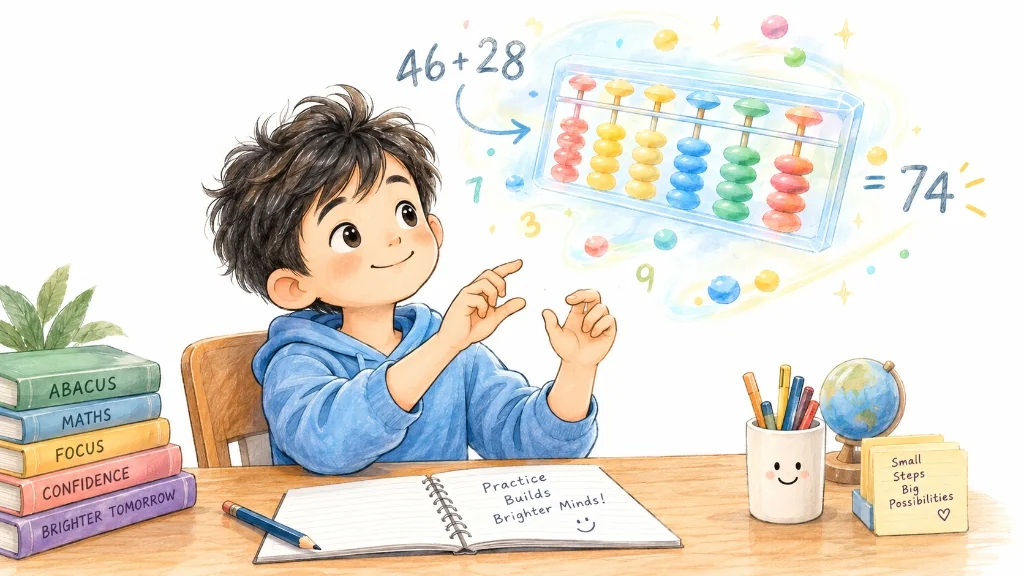
How Children Learn to "See" Numbers Instead of Reciting Them
The Verbal Bottleneck: Most children learn mathematics verbally. When they look at a number like 583, their brains convert the visual digits into an auditory phrase: “five hundred and eighty-three.” When performing multi-digit addition or subtraction on paper, they rely heavily on language-based working memory—repeating carryovers and steps under their breath.
This verbal pathway is cognitively heavy. When numbers get longer or calculations move faster, verbal memory quickly bottlenecks and mental fatigue sets in.
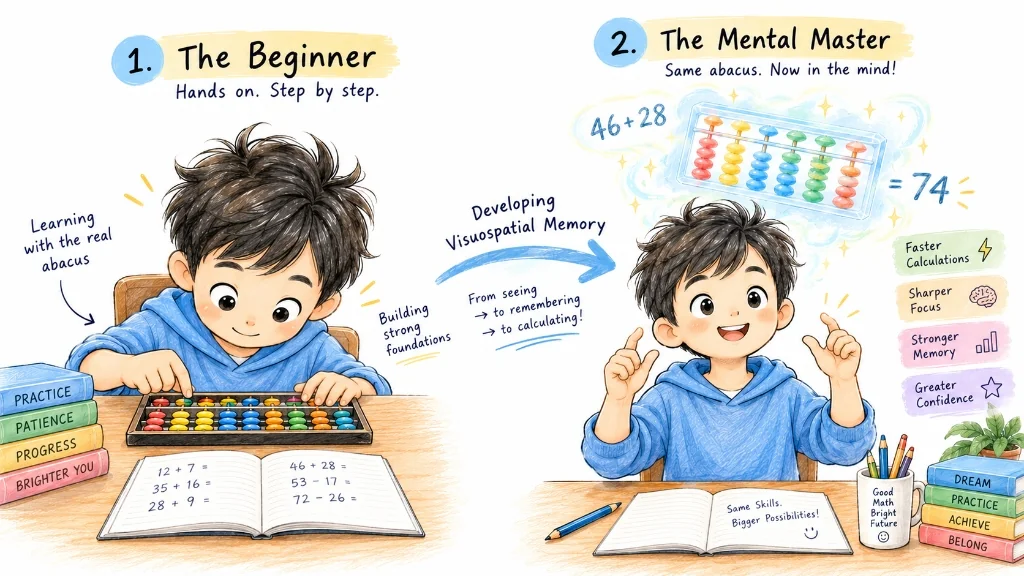
The Visuospatial Shift: Abacus instruction introduces a completely different coding mechanism. Numbers cease to be abstract text or sound bites. Instead, they become a concrete, physical arrangement of beads on vertical rods. Each column directly anchors place value (units, tens, hundreds), and every movement represents an exact quantity.
Verbal & Symbolic
Numbers are processed as spoken words and written symbols. Memory relies on silent recitation and rule memorization.
Visuospatial & Structural
Numbers are processed as spatial bead arrangements. Memory relies on visual-motor coordinates and instant mental snapshots.
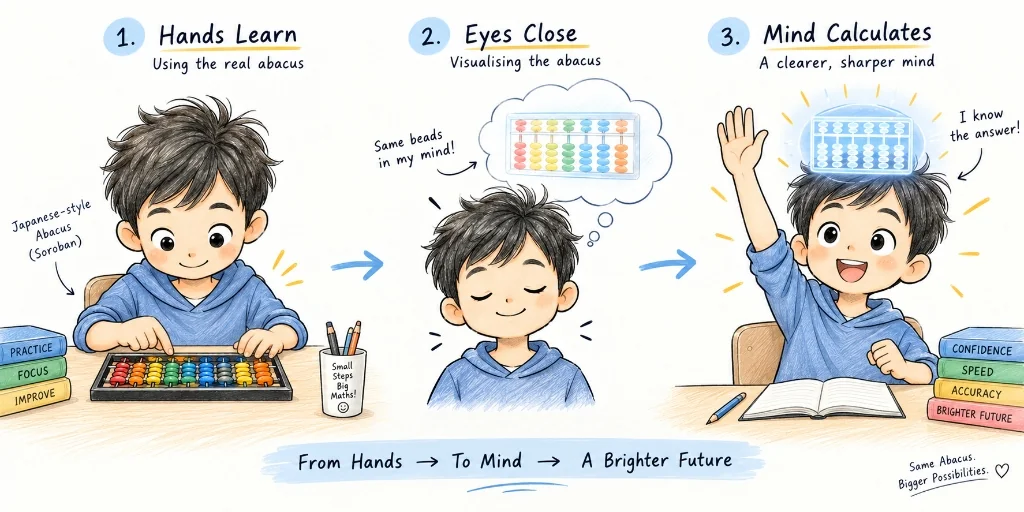
Over months of deliberate practice, children no longer need the plastic or wooden frame in front of them. The motor patterns and bead arrangements become an internalized visual map.
The 3 Phases of Development: Hands Learn → Eyes Close → Mind Calculates
Children do not start calculating complex equations mentally overnight. The transition follows three distinct developmental phases that match how young brains naturally absorb concepts:
The Real Cognitive Engine: Visuospatial Working Memory
A Neurobiological Shift: When researchers scan the brains of mental abacus students during arithmetic, they observe a noticeable neurobiological shift. While untrained individuals primarily activate the brain's left-hemisphere language networks to crunch numbers, experienced abacus users activate bilateral fronto-parietal circuits—regions responsible for visual attention and spatial manipulation.
In a systematic review of abacus research published in Frontiers in Psychology (Wang, 2021), researchers evaluated dozens of cognitive studies tracking children over multiple years. The most robust, consistent finding across the literature is a marked improvement in two interrelated areas:
- Arithmetic Performance & Fact Retrieval: Children demonstrate significantly faster response times, higher accuracy in multi-digit problems, and stronger intuitive number sense.
- Visuospatial Working Memory: The ability to hold, update, and manipulate visual information in the mind's eye without losing track of previous states.
Why Fingers Gesture in the Air: This explains why children learning mental abacus often twitch their index fingers and thumbs in the air while solving math. Those finger gestures are not nervous ticks; they are physical spatial anchors that help the child track bead positions in their internal working memory.
Debunking the Hype: What Abacus Does (and Doesn't) Do
Separating Facts from Marketing: Because watching a nine-year-old add twelve columns of numbers in seconds is so striking, commercial learning centers frequently make exaggerated promises. You may see promotional materials claiming that abacus training "doubles your child's overall IQ," "guarantees academic genius," or "unlocks whole-brain superpowers."
Rigorous research paints a more grounded, honest picture. In cognitive psychology, researchers distinguish between marketing claims and real, proven gains:
| Common Myth | What Science Proves |
|---|---|
|
Claim 1
“Abacus doubles overall IQ and guarantees genius in every school subject.” |
Targeted, profound math gains: Longitudinal trials show exceptional calculation speed, working memory, and place-value mastery, but no automatic spillover into unrelated fields like reading comprehension or general verbal reasoning (Barner et al., 2016). |
|
Claim 2
“It’s just rote formula memorization done mechanically faster.” |
Structural brain rewiring: Brain imaging confirms children switch from language-based recitation to active visuospatial processing in fronto-parietal circuits, building deep intuitive number sense. |
|
Claim 3
“Children must drill for hours every single day to get results.” |
Consistency beats intensity: 10 to 15 minutes of regular interactive daily practice builds sharper neural pathways and preserves joy, while exhausting weekend marathon sessions cause burnout. |
Why This Is Good News for Parents: This distinction is reassuring. Abacus is not an all-purpose intelligence upgrade, nor does it need to be. It is an exceptionally effective pedagogical system for eliminating math anxiety, cultivating fast numerical fluency, and turning numbers into something tangible and intuitive rather than intimidating.
What Parents Should Look for in a Class or Practice Tool
If you are exploring abacus for your child, keep in mind that the instrument itself is only as good as the learning environment. Tap each question below to inspect what matters most:
Watch out for programs that force formula memorization before children grasp bead values and complementary pairs (like Small Friend +5 and Big Friend +10 combinations). Grasping the "why" before the "how" prevents rote confusion.
Children should only begin imagining beads after their physical bead manipulation is secure and confident. Forcing mental work too early causes stress and fragile mental models.
Speed is naturally born from practice and familiarity. Rushing a child before they achieve high accuracy degrades their mental image and causes unnecessary frustration.
Every child's spatial memory develops at a different cadence. Rigid classroom groups that force identical pacing often leave sensitive learners behind or bore fast movers.
Studies showing significant cognitive gains involved sustained practice over months or years. Ten to fifteen minutes of daily interactive practice is far more effective than an exhausting two-hour weekend cram session.
The Takeaway for Parents
Beyond Mere Speed: Ultimately, the lasting benefit of mental abacus is not just that a child can compute 847 + 296 = 1143 in a few seconds.
The true value is that math stops feeling like a chore. By transforming abstract digits into physical coordinates, spatial movements, and clear mental images, abacus demystifies numbers at the exact age when many students develop lifelong math avoidance.
When children realize they can hold and solve calculations inside their own imagination, their confidence shifts—not just in math class, but in how they approach challenging problems in everyday life.
This article draws directly on empirical research synthesised in: “Cognitive training using the abacus: a literature review study on the benefits for different age groups” (Wang, 2021), published in Frontiers in Psychology and indexed on PubMed Central (PMC8283869), alongside longitudinal evaluations of mental calculation training (Barner et al., 2016).